
Views: 0 Author: Site Editor Publish Time: 2026-06-29 Origin: Site


The structural integrity, thermal efficiency, and contamination control capabilities of any controlled environment rely fundamentally on the engineering of its wall and ceiling systems. Selecting an incompatible core material, surface coating, or manufacturing method for cleanroom panels leads to regulatory compliance failures, thermal inefficiencies, or severe fire safety hazards. These missteps often result in costly facility downtime, failed audits, or complete retrofits. Facility engineers, architects, and procurement teams must evaluate the technical specifications, manufacturing methods, and operational trade-offs of modern panel materials. Making evidence-based structural decisions ensures compliance, safety, and long-term performance across pharmaceutical, semiconductor, and biotechnology applications. You need a clear understanding of how core materials interact with surface coatings under strict environmental controls to prevent particulate shedding and maintain pressure cascades.
Application Dictates Material: Core material selection directly governs fire resistance, thermal insulation (R-value), and structural load capacity, requiring strict alignment with facility use-cases (e.g., biopharma vs. microelectronics).
Manufacturing Methods Matter: The choice between handmade cleanroom panels and machine-made cleanroom panels dictates customization limits, structural rigidity, connection profiles, and project lead times.
Compliance is Non-Negotiable: Regulatory standards (ISO 14644, GMP, FDA) require specific surface-to-core combinations to prevent particulate shedding, outgassing, and microbial growth.
Controlled environments demand flush, seamless transitions to eliminate particulate accumulation zones. Any gap or ridge becomes a breeding ground for contaminants. Panels must withstand aggressive chemical cleaning agents, such as vaporized hydrogen peroxide (VHP), isopropyl alcohol (IPA), and bleach, without degrading the surface. When you design a facility for pharmaceutical manufacturing, the wall systems face daily exposure to these harsh sterilants. If the panel coating fails, the underlying steel rusts, leading to immediate particulate generation and failed environmental monitoring tests.
Compliance with ISO 14644-15 for assessing airborne molecular contamination is mandatory. Semiconductor environments require low-outgassing materials to prevent microscopic defects on silicon wafers. The outer skin and core combination must guarantee zero particulate shedding over the facility's lifespan. We test these surfaces using particle counters and surface swab sampling to verify that the panel joints and silicone sealants do not release volatile organic compounds (VOCs) into the airstream.
Verify chemical compatibility with the facility's standard operating procedures for cleaning.
Review outgassing test reports for all sealants and core materials.
Inspect panel joints for flush alignment to ensure no ledges exceed 1mm.
Conduct baseline particle counts before and after simulated cleaning cycles.
Panel R-values and thermal conductivity (U-values) play a major role in maintaining strict temperature and humidity controls. High thermal efficiency reduces the load on HVAC systems, ensuring stable environmental conditions. Poor insulation leads to condensation, which compromises sterility. In cold storage or low-humidity dry rooms, thermal bridging at the panel joints causes localized condensation. This moisture supports microbial growth and degrades the panel core over time.
Acoustic dampening is necessary for operator comfort. Environments housing heavy machinery or high-velocity HVAC systems require panels with high Sound Transmission Class (STC) ratings. Effective acoustic control prevents fatigue and improves workplace safety. We often specify mineral wool cores in mechanical corridors specifically to absorb the low-frequency hum of air handling units and exhaust fans.
Non-combustible materials are essential to meet local fire codes, ASTM E84 Flame Spread Index, and Factory Mutual (FM) approvals. Fire-rated panels prevent rapid flame propagation and minimize smoke generation during an emergency. Facility insurers mandate specific fire ratings based on the occupancy type and the presence of flammable solvents. Failing to specify the correct fire-rated core results in denied occupancy permits.
Load-bearing requirements dictate the design of walkable ceiling panels. Ceilings must support point loads of 150 kg/m² to 200 kg/m² to allow maintenance access without compromising the cleanroom envelope. Structural failure in a ceiling panel can lead to catastrophic contamination events. Maintenance personnel need safe access to HEPA filter housings, lighting ballasts, and utility valves located above the cleanroom ceiling. The panel system must distribute this dynamic load across the suspension grid without deflecting.
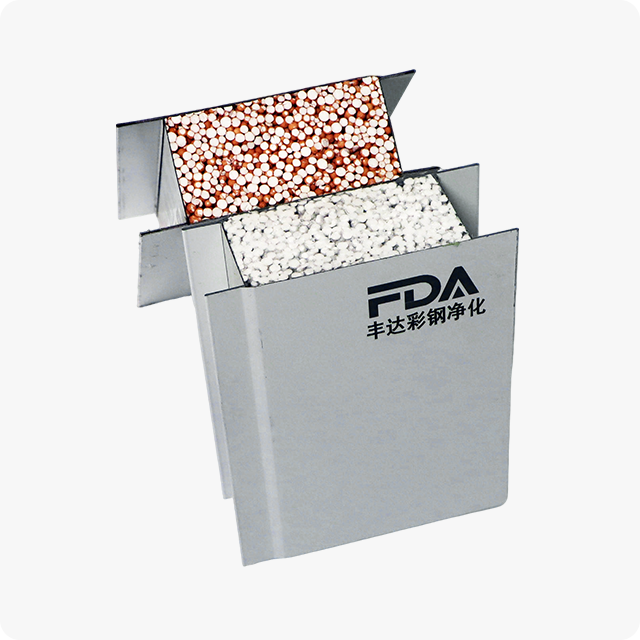
Continuous-line high-pressure systems produce machine-made cleanroom panels. This method results in standardized widths, typically 1150mm, and continuous lengths. The automated process ensures high-volume output and rapid production schedules. Steel coils feed into a roll former, the core material is injected or glued in place, and the assembly passes through a heated press to cure the adhesive. This continuous lamination process yields thousands of square meters per day.
These panels offer consistent skin tension and lower unit costs. However, they have lower structural rigidity due to the absence of internal perimeter framing. Thickness options are limited, and customization for complex facility layouts is restricted. They utilize a standard tongue-and-groove joint profile, which requires external structural support for high-span ceilings. You cannot easily cut large penetrations for return air grilles without compromising the panel's structural integrity.
They are ideal for large-scale, lower-tier ISO cleanrooms (ISO 7 to ISO 9) with standard ceiling heights and minimal walkable ceiling requirements. Electronics assembly halls and packaging areas frequently utilize this manufacturing style to cover large square footages rapidly.
Factory technicians manually assemble handmade cleanroom panels, integrating reinforced steel, aluminum, or composite frames (keels) around the perimeter of each board. This construction provides superior structural integrity and high load-bearing capacity for walkable ceilings, eliminating the need for extensive secondary steel structures. The internal frame acts as a structural skeleton, allowing the panel to span greater distances without deflecting under load.
They allow infinite customization for precut openings, including HVAC, lighting, utility columns, and pass-throughs. The factory cuts and frames these penetrations before lamination, ensuring the core remains sealed. The primary limitations are longer lead times and higher initial procurement costs. They use double-female joints with aluminum insert splines, yielding flat, flush, and structurally superior connections. This joint design allows for easier individual panel replacement if damage occurs during operation.
These are best suited for high-grade GMP pharmaceutical facilities (Grade A/B), complex architectural layouts, and environments requiring heavy ceiling-mounted equipment access. Biologics manufacturing suites rely on this panel type to support the heavy infrastructure required for bioreactors and purification skids.
Rockwool panels feature a density of 100–120 kg/m³ and offer exceptional fire resistance. They are Class A non-combustible and can achieve up to 1- or 2-hour fire-rated partitions. The thermal conductivity is approximately 0.044 W/m·K. Manufacturers slice high-density mineral wool boards into strips and rotate them 90 degrees so the fibers run perpendicular to the steel faces. This orientation maximizes compressive strength and shear resistance.
The high self-weight increases installation complexity and structural load on supports. Installers need mechanical lifting aids to position ceiling panels safely. Rockwool is highly susceptible to moisture absorption if the outer steel skin is breached, leading to a complete loss of insulation value. Wet rockwool also promotes corrosion of the internal steel faces from the inside out. They are best for high fire-risk environments, pharmaceutical manufacturing requiring GMP fire-separation walls, and facilities with strict local fire code mandates.
PU and PIR panels have a density of 40–42 kg/m³. They provide superior thermal insulation, offering the highest R-value per inch with a thermal conductivity of roughly 0.022 W/m·K. The closed-cell structure (>95% closed-cell) inherently resists moisture. The manufacturing process injects liquid foam between the steel sheets, which expands and cures, creating a monolithic bond that provides excellent shear strength.
They are combustible under extreme heat, though PIR offers significantly better fire performance and char-formation than standard PU, typically achieving Class B1 fire ratings. There is a potential for micro-outgassing in ultra-sensitive semiconductor environments. They are ideal for cold storage cleanrooms, temperature-critical biological archives, and food processing facilities where maintaining strict temperature gradients is the primary operational goal.
Aluminum honeycomb cores feature cell sizes ranging from 6mm to 12mm. They deliver an outstanding strength-to-weight ratio, are 100% non-combustible, produce zero outgassing, and remain highly rigid under deflection. The hexagonal cellular structure mimics aerospace engineering principles, providing a perfectly flat surface that will not bow or warp under pressure differentials.
They suffer from poor thermal insulation properties due to high thermal transfer through the aluminum structure. You must account for this when calculating HVAC loads in facilities with large temperature differentials between zones. They are best for semiconductor manufacturing (ISO 1 to ISO 5), microelectronics, aerospace optics, and static-sensitive environments requiring flat, deflection-free walls.
Contractors use EPS foam clean boards for their density of 15–20 kg/m³. They are highly cost-effective, extremely lightweight, and offer moderate thermal insulation and water absorption resistance. The lightweight nature allows for rapid manual installation without heavy lifting equipment, accelerating project timelines for temporary structures.
They have poor fire resistance, melting and burning easily while releasing toxic smoke, and they fail strict FM approvals. They also have lower structural integrity and poor load-bearing capacity compared to Rockwool or Honeycomb cores. You cannot use these for walkable ceilings. They are suitable for budget-conscious projects, temporary enclosures, or lower-tier ISO classes where strict fire codes and heavy ceiling walkability are not constraints.
MgO panels possess high density and hard-surface characteristics. They provide excellent fire resistance, sound dampening, and high moisture resistance, as they do not degrade when wet. The core consists of a cementitious board that offers extreme impact resistance, making it suitable for high-traffic corridors where carts and equipment might strike the walls.
They are very heavy, brittle to cut on-site, incur higher shipping costs, and are susceptible to chloride corrosion if low-grade MgO formulations are used with standard galvanized skins. Installers must use specialized diamond-tipped blades to cut penetrations. They are best for heavy-duty cleanrooms requiring impact resistance, high humidity resistance, and exceptional fire performance.
Paper honeycomb panels are lightweight, cost-effective, and offer high flatness with moderate compressive strength when dry. The core consists of recycled kraft paper expanded into a hexagonal grid. This provides a rigid backing for the steel faces at a fraction of the cost of aluminum honeycomb.
They have zero moisture resistance and are highly susceptible to structural collapse if exposed to water or humidity during installation or cleaning. They offer zero fire-retardant capacity unless chemically treated. They are best for general electronic assembly and dry environments requiring a flat panel surface on a restricted budget.
PPGI is the standard industry choice, balancing cost with durability and moderate chemical resistance. The base steel receives a zinc coating before the application of primer and topcoats. PE (Polyester) coatings are used for standard environments, while PVDF (Polyvinylidene Fluoride) coatings provide advanced UV and chemical resistance. PVDF withstands frequent wipe-downs with harsh solvents without fading or chalking.
Stainless steel is required for highly corrosive environments, heavy washdown areas, and strict aseptic GMP zones. SUS 316L is preferred for environments using chlorine-based sanitizers or continuous VHP sterilization cycles due to its superior pitting resistance. The non-porous surface prevents microbial adherence and withstands physical impacts from heavy equipment.
HPL offers excellent impact and scratch resistance, anti-static properties, and resistance to aggressive chemical sterilization. It consists of multiple layers of kraft paper impregnated with phenolic resin, compressed under high heat. It is ideal for high-traffic healthcare and pharmaceutical corridors where durability is paramount. HPL panels do not dent like steel-faced panels.
Anti-Static (ESD) Coatings are essential for dissipating static charges in electronics and semiconductor environments. These coatings incorporate conductive materials that route static electricity to the facility's grounding system. Anti-Microbial Coatings are formulated with silver-ion or specialized biocide technologies to continuously inhibit bacterial and fungal growth on panel surfaces, providing a secondary defense mechanism in biological cleanrooms.
Core Material | Fire Rating | R-Value | Weight | Moisture Resistance | Primary Application |
|---|---|---|---|---|---|
Rockwool | Excellent (Class A) | Moderate | High | Low | GMP Pharma, Fire Walls |
PIR/PU | Moderate-Good (B1) | Excellent | Low | High | Cold Storage, Dry Rooms |
Aluminum Honeycomb | Excellent (Class A) | Poor | Low | High | Semiconductor, Microelectronics |
EPS Foam | Poor | Moderate-Good | Low | Moderate-High | Temporary Enclosures, ISO 8/9 |
Magnesium Oxide (MgO) | Excellent | Moderate | High | High | High-Impact Corridors |
Proper installation dictates the final performance of the cleanroom envelope. Even the highest-grade panels fail if the joint sealing and floor track integration are executed poorly. The floor track must be perfectly leveled using laser transits before the first wall panel is set. Any deviation in the base track translates to compounding vertical errors, resulting in uneven panel joints and compromised seals.
Wall-to-floor transitions require coving to eliminate 90-degree angles where dirt accumulates. Aluminum or PVC cove bases snap into the floor track, providing a smooth, cleanable radius. The joints between panels receive a continuous bead of cleanroom-grade, non-outgassing silicone sealant. Installers must tool the silicone flush with the panel surface to prevent ledges.
Level the aluminum base track to within 2mm over a 10-meter span.
Apply continuous butyl tape under the floor track to seal against the concrete slab.
Insert aluminum splines into the vertical joints of handmade panels to ensure planar alignment.
Tool all silicone joints flush, removing excess material immediately to prevent smearing.
Install ceiling suspension threaded rods directly to the primary building steel, avoiding secondary purlins if possible.
To ensure a successful cleanroom build, start by mapping your specific ISO or GMP regulatory requirements to the appropriate core and surface materials. Next, evaluate your ceiling load-bearing needs to determine if handmade or machine-made panels are required. Finally, consult with a structural engineer to verify that your selected materials meet local fire codes and HVAC thermal load calculations. Establish a strict quality control protocol for the installation phase to guarantee flush joints and proper silicone application.
A: Handmade panels have internal perimeter frames for high structural rigidity and load-bearing capacity, making them ideal for walkable ceilings. Machine-made panels lack this frame, offering faster production and lower costs but less structural strength.
A: Rockwool provides exceptional fire resistance and meets strict GMP fire-separation requirements. It is non-combustible, which prevents rapid flame spread in high-risk manufacturing environments.
A: EPS foam panels are generally not recommended for ISO 5 environments due to strict fire safety codes and potential outgassing. They are better suited for lower-tier ISO classes or temporary enclosures.
A: Stainless steel (specifically SUS 316L) or PVDF-coated PPGI are the best choices for environments using continuous Vaporized Hydrogen Peroxide (VHP) sterilization, as they resist chemical degradation.
A: Aluminum honeycomb has poor thermal insulation properties because the aluminum structure facilitates high thermal transfer. It is chosen for its strength, non-combustibility, and zero outgassing rather than its R-value.
A: Installers use cleanroom-grade, non-outgassing silicone sealant. The silicone is applied continuously along the joint and tooled flush with the panel surface to prevent any ledges where particles could accumulate.


